
Blackjack vs poker: two completely different games pretending to be related
A practical comparison of blackjack and poker strategy for crypto casino players, using decision trees to understand the real differences.
Table of Contents
They share a deck of cards and almost nothing else
I've played both games seriously for years, and the most common mistake I see new players make is treating them as variations of the same thing. They're not. Blackjack is a puzzle with a known solution. Poker is a war where the terrain changes every hand. Understanding this distinction before you sit down at either table will save you money and frustration.
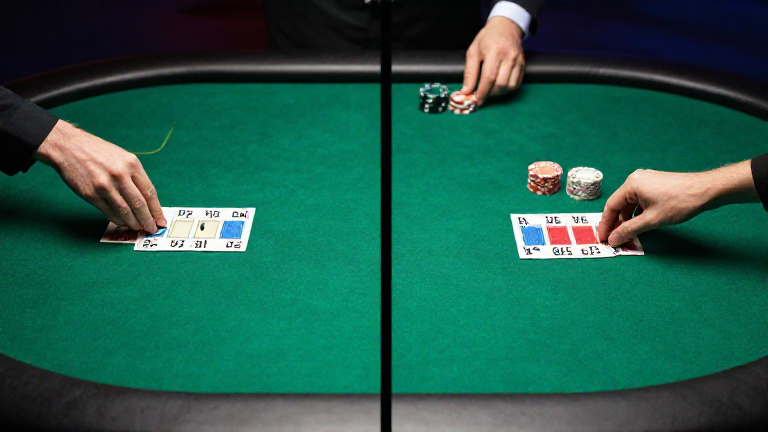
The clearest way to see the difference is through decision trees. Blackjack gives you a shallow, repeated pattern of choices. Poker builds deep branches where opponent behavior and stack sizes keep reshaping every option's value. Once you internalize those structures, the gap in mental load, odds, and required skills becomes obvious.
Blackjack: the algorithm you can memorize
In blackjack, you're playing against the house. The dealer follows fixed rules and makes zero decisions during play. Whether they hit or stand on soft 17 depends on the variant, but the point is they don't get to choose. Your job is to respond optimally based on your hand and the dealer's visible card.
This makes the game beautifully analyzable. With perfect play, most online blackjack variants carry a house edge between 0.5% and 1%. That's remarkably thin. The decision tree has just a few layers:
The deal comes first, where you get two cards and see one of the dealer's. Then your choice layer: hit, stand, double, split, or surrender. Finally resolution, where the dealer draws according to their fixed rules. Basic strategy charts map every possible combination. Play long enough and the moves become automatic.
I find this satisfying in a specific way. There's comfort in knowing the mathematically correct play exists for every situation. You're not guessing. You're executing. The variant details matter though. Deck count, doubling rules, surrender availability. Each tweak shifts the optimal strategy slightly. On Stake you can find multiple blackjack variants, and it's worth checking the specific rules before assuming your standard chart applies.
Poker: where the math is just the starting point
Poker flips nearly everything about blackjack. You're facing other players, not the house. The casino earns from rake, not a built-in edge. And the decision tree gets deeper with every street.
Before the flop, you decide which hands to play based on position and table dynamics. On each subsequent street, you choose between checking, calling, betting, or raising. Your opponents answer, branching the tree again. There's no basic strategy chart for no-limit hold'em because the correct play depends on who you're playing against.
Strong poker players work with starting ranges, position, pot odds, and bluffing frequencies, then adjust everything in real time based on stack depth, table texture, and opponent tendencies. The same hand played identically in two different spots can be brilliant or terrible depending on context.
This is why poker rewards sustained study in a way blackjack doesn't. In blackjack, once you've memorized basic strategy, the marginal gains from additional study are tiny (unless you're counting cards, which online casinos prevent). In poker, you can spend years refining your game and still find edges to exploit.
The odds comparison everyone gets wrong
People love asking "which game has better odds?" as if that's a simple question. In blackjack, the house edge is fixed by the rules. You can calculate it precisely for any variant. In poker, your edge depends entirely on your skill relative to your opponents. A world-class player at a soft table has a massive advantage. The same player at a tough table might barely break even after rake.
This means poker has theoretically unlimited upside but also unlimited downside. Blackjack caps both. You'll never crush blackjack for 20% ROI over thousands of hands with perfect play. But you also won't go broke from a skill deficit the way you can in poker.
For crypto casino players specifically, games like Mental at 96.08% RTP offer a middle ground. Fixed-odds games with known return rates let you calculate expected loss precisely, which is useful for bankroll planning.
Which game fits your brain
I think the choice comes down to personality more than skill level. If you like executing a well-studied plan against a predictable opponent, blackjack is your game. The satisfaction comes from precision, from knowing you played every hand correctly regardless of outcome.
If you thrive in ambiguity, if you enjoy reading people and adapting on the fly, poker will feel more rewarding. The satisfaction comes from outthinking someone, from making a read that turns a losing hand into a winning one.
Some players excel at both, but they're rare. The mental muscles are different. Blackjack discipline is about suppressing impulse and following the chart. Poker discipline is about controlled aggression and knowing when to deviate from your default lines.
Practical advice for crypto players
Whatever you choose, treat it as structured entertainment. Set session limits before you start. Keep notes on your results over time, even rough ones. Step back when the swings feel uncomfortable.
If you're trying to decide, compare casinos for their table game selection. Some platforms are stronger on blackjack variants while others have better poker traffic. The right platform for you depends on which game you're committing to.
And regardless of which side you land on, learn the other game at low stakes. Blackjack teaches you to follow a system without letting emotions interfere. Poker teaches you to think about expected value in uncertain situations. Both skills transfer to every other game you'll play across crypto casinos, from slots to casino games of every type.

Crypto Gaming DB editorial contributor.
Continue Reading
I've been on tilt more times than I'll admit, here's what actually helps
Practical mental strategies for handling losing streaks in crypto poker and casino games, from bankroll rules to emotional pattern recognition.
Your bankroll management is probably wrong, and it's costing you sessions
Practical crypto casino bankroll management strategies that keep your play sustainable and your budget intact.
Genius Sports vs LSports: what crypto sportsbooks should actually care about
A practical comparison of Genius Sports and LSports data APIs for operators building crypto sports betting platforms.